Hunger. Emptiness. Heartbreak—A chapter of learning through pain.
READ CHAPTER-08:
Price of Fire – A Human Resilience Fiction on Faith, Loss, and Becoming
🔒 Free Chapter Usage & Copyright Notice
Copyright © 2025 by The Writer. All rights reserved.
ISBN: 978-984-35-7698-9
This Learning Through Pain is part of a plain text version of a published title from the Zyphar Chronicles series. This edition is offered for free reading only, and is intended to help readers preview and explore the world of Zyphar. The full symbolic and graphical edition — designed to enhance immersion and interpretation — is available through the official Amazon release.
No part of this work may be copied, stored, or reused in any form — electronic, print, mechanical, or otherwise — without prior written permission from the copyright holder, except for short excerpts used in academic, critical, or review contexts.
⚖️ AI Use Restriction
This content is not licensed, sold, or authorized for use in any machine learning, artificial intelligence training, dataset compilation, or automated content generation. Any attempt to scrape, reproduce, or process this work for AI training or synthetic reuse is strictly prohibited.
This book belongs to the tradition of Learning Through Pain and literary storytelling. Names, characters, places, and systems are fictional or symbolic. Any resemblance to real individuals or entities is coincidental or intentionally allegorical.
Author: Zyphar Animas
Editor: Nimo Verin
Publisher: Print & Digital
Published: 2025
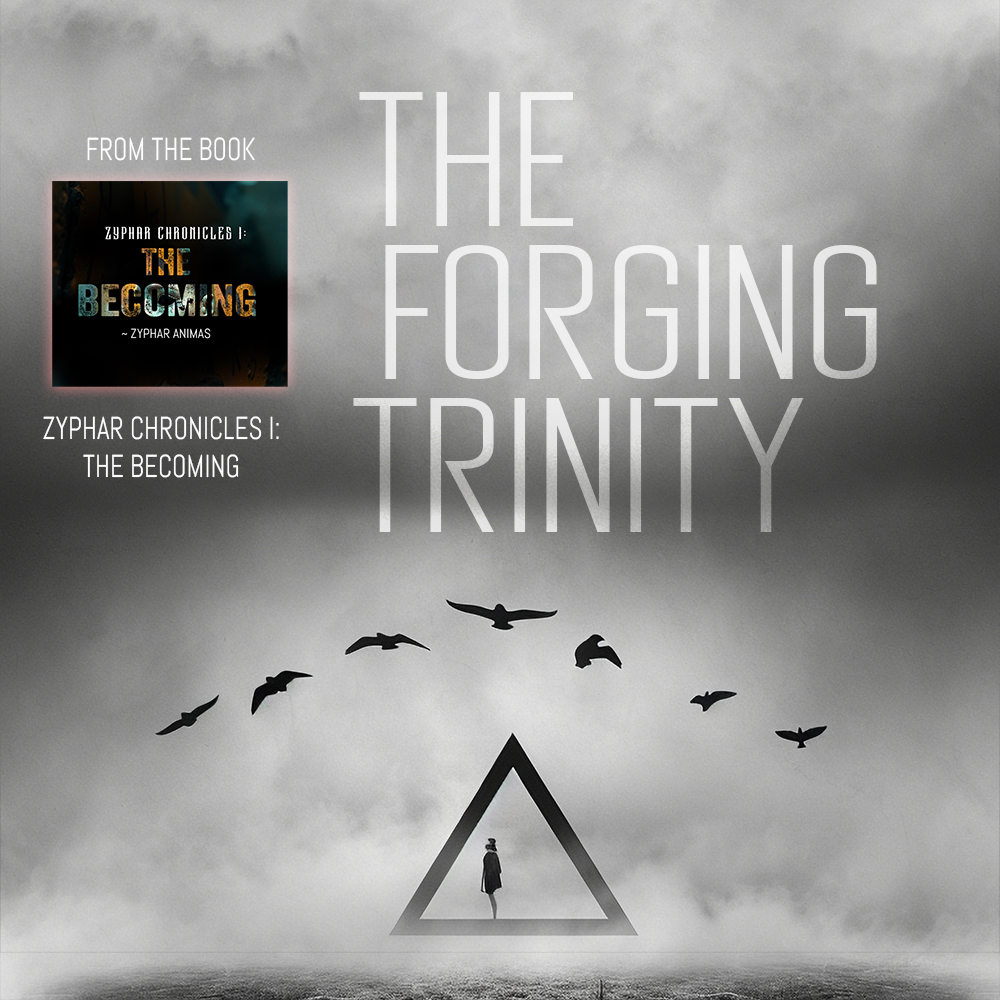
THE FORGING TRINITY
Nimo was holding me like I was still that child—the one I had just finished describing, as if the past hadn’t ended.
Her arms wrapped around my side with a tenderness that said she hadn’t simply heard the story, she had lived it through my voice. She didn’t speak. But for a moment, I felt her breath catch—one soft, broken sound that cracked quietly into a sob she didn’t try to hide.
No one stopped her.
Not Marisha. Not the man beside her who had once held the room like a judge. They were watching me now with something I hadn’t seen before. Something closer to recognition.
And since the silence gave no reason to pause—I moved forward, and let the fire speak again.
I was just… sitting in the dark—alone, vulnerable—outside the door I had once called my home, the place I had grown into with memories and small hopes I didn’t know I’d built.
I had knocked on every door I could find—tried every alley, every promise, every shoulder.
None of them worked. And by then, I had stopped expecting.
There was no point in repeating failure when the silence had already answered. I was thinking that maybe I should move to another city tomorrow.
“Learning through pain isn’t punishment—it’s the slow art of becoming who you were meant to be.”
— Zyphar Chronicles I: The Becoming
No plan.
Just the desire to walk until the past no longer recognized me.
I must have fallen asleep, not from rest, but from exhaustion— the kind of collapse that only comes after the soul gives up waiting for its name to be called again.
And then—I woke up.
It was past midnight. The street was dead. The light was gone.
And in front of me—three faces.
Horrible. Unfamiliar. Almost inhuman.
I felt a fear I can’t describe.
The kind that makes the body prepare to run before the mind understands why. But before I could stand, they spoke.
They said they had been sent. By the Lord.
And for a moment— just one wild, aching moment—I thought, finally.
Finally, He remembered.
Finally, He would repay something of what He owed, even if it was small. I was ready to hear anything. Ready to follow.
But what they said next—destroyed that thought completely. They told me the Lord still did not recognize me.
That I was not owed anything.
That I was not even counted.
But—in a rare gesture of something they would not name— He had decided to give me a chance.
Not favor. A chance.
And so, He had sent His finest teachers.
The first came forward, face sharp and sunken.
He said, “I’m Hunger.”
The second—thin, with eyes like ash—spoke after. “I am Emptiness.”
And the third, who seemed the quietest but whose presence hurt the most, said only this: “I am Heartbreak.”
I didn’t know such teachers existed.
No one told me pain could wear names and speak with dignity. But I had no options. Nowhere else to go.
Nothing left to protect.
So I nodded. And without ceremony, I accepted their lessons.
Nimo was still listening, her eyes fixed to mine like she had not just heard the story but relived it inside her own skin. But I had to stop—just for a breath—because something shifted around us.
The man—Marisha’s husband, the one who had always felt off to me in small, unspoken ways—suddenly stood with urgency, with something like revelation in his eyes.
And before I could speak, he rushed forward.
He moved Nimo gently aside with his hand, and then threw his arms around me in an embrace that felt more like a claim than affection. He held me tightly and said, almost shaking:
“This is it, my beloved friend. I’ve roamed everywhere for this. And I know—you don’t remember me. You can’t, even if you try. But I’ve come to understand…it is you.”
“You are the one who can listen to the silence. The one who can speak in it. And silence—Zyphar—is the language of the Lord.”
I didn’t move.
I just listened.
“I’ve gained everything this world can offer,” he continued, his breath trembling, “I’ve been to every corner, but I couldn’t find a single Animas—not one who could speak to the Lord as you have. I didn’t believe it at first, but now I understand.”
“The voice that speaks not with sound but with silence—He gave it to you. You were taught by the finest teachers in His academy.” “Hunger. Emptiness. Heartbreak.”
His eyes were wide, as if he’d seen some divine blueprint written into my skin. “And even if you never say another word,” he whispered, “what’s written on your face is already the final statement of the Lord.”
There was awe in his voice, but also a hunger I couldn’t place. And for a split second—just one heartbeat—I saw it in his eyes. The VOID.
The same one I once saw in the gaze of the Divine Trap during my time in the City of Smoke and Mirrors.
Not imagined. It was real.
It lasted only a second—then vanished like it had never been there. I said nothing. But I looked to the sisters.
Both Marisha and Nimo were off balance—visibly unsettled by the man’s performance, unsure whether it was madness or revelation or something in between.
And after a silence no one dared to interrupt, they both asked me, softly—almost in unison—to continue. So I did.
The teachers were tough—so strict and harsh it sometimes felt cruel, and I couldn’t tell if they were helping me grow or just breaking me down.
They didn’t use any scrolls, and never explained what they were doing or why. It didn’t feel like education—it felt like execution under the guise of instruction.
They seemed more like doctors than teachers, but not the kind who heal. They were more like harsh surgeons, trying to see if my heart still beat like a real man’s. They didn’t explore gently— they cut deep, without any kind of anesthesia.
There are no words clean enough to describe what it felt like. I was breaking—not once or twice, but every day.
I watched myself torn into pieces so small even memory couldn’t name them, and then I was told to gather those pieces, without guidance, without grace, and rebuild myself again by hand.
It was a kind of brutality that touched both body and mind at once—leaving me hollowed, exposed, and somehow still breathing.
I was left in hunger not for a moment, not even for days, but for months that blurred together until I forgot the shape of fullness.
I was left in shame that lasted not as a feeling, but as a condition—placed in front of every eye in the city as though my ruin were a monument they had been waiting to see.
I was made naked, not just in form, but in essence.
They put me in front of the world with no name and no story, letting people throw their hate at me like I deserved it.
I wanted to die. Every morning I woke up and questioned whether it was still worth breathing.
But the teachers, in their unflinching rhythm, never let me fall too far. They kept me alive, not out of mercy, but because suffering, to them, was a necessary continuation.
And each night—after the day’s tearing, after the lesson carved into me had finished bleeding—they returned. They stood at my side, one by one, and asked, without emotion— If I wished to file a complaint to the throne of the Lord.
Every night I said no.
And every morning they returned.
Beginning again as though the refusal had never been spoken. This continued—not for weeks, not for seasons, but for years. Years without clarity. Years without reward.
Years without the comfort of purpose.
Only repetition. Only the sound of my own pain, echoing between the blades they held.
I don’t know how much time had passed by then.
At some point, I had stopped counting.
Days blurred into years, and years folded into silence.
There was no measure left—only the pain and survival.
One morning, like any other, I rose from the ground and walked toward the teachers, expecting the day’s lesson—whatever form of punishment or erosion they had designed next.
But they didn’t greet me the same way.
There was no demand.
Instead, one of them stepped forward—the one who had first called himself Hunger—and said, “Boy of Animas, we believe the teachings have run their course. The time has come for testimony.”
I didn’t speak. He continued.
“Consider this your internship. Before we speak of graduation, before we allow you the right to a name of your own, you must take what you’ve been given and walk it through the world.”
“If you survive it. If you carry it with precision, you may return not only with a name, but perhaps a title.”
“Maybe even one worthy of remembering.”
I didn’t understand all of what he said.
Their words were always layered—part instruction, part prophecy, part threat.
But it didn’t matter.
I wasn’t being offered a choice.
So I agreed.
And without ceremony.
Without blessing or explanation.
They opened a door.
This story is also released as a standalone social media edition titled “The Forging Trinity: A Learning Through Pain.”
A concise version of that story follows below.
Want to read more? Enter your details for exclusive access to advanced reader copies and new story updates from Zyphar Animas.
Story Summary
The Forging Trinity unfolds as a mythic journey of learning through pain, where the soul is tempered not by miracles but by hunger, emptiness, and heartbreak. These three—called teachers rather than tormentors—become the sacred forces that strip away illusion until only truth remains. Through their brutal lessons, the narrator learns that survival is not the same as life; it is the discipline of being reshaped by suffering.
This chapter embodies the essence of learning through pain—that endurance is not passive, and growth is not gentle. It portrays the silent apprenticeship of becoming: when everything once held dear is taken, and what’s left is forged into meaning. In the stillness between agony and awakening, The Forging Trinity reminds us that the human spirit is educated not in peace, but in fire.
For readers drawn to fiction that explores learning through pain, this story offers both catharsis and clarity—a mirror for anyone who has been broken, and yet chosen to rise.
Beta Readers Reactions
“The Forging Trinity changed how I see suffering. This is not just storytelling—it’s an anatomy of the soul learning through pain. Every sentence feels like truth carved by fire.”
— Elena M., Madrid
“I found myself trembling by the end. Few stories capture learning through pain with this kind of beauty and restraint. It hurts, heals, and humbles—all at once.”
— Noah R., Melbourne
“This chapter gave words to what I’ve lived but never said. The Forging Trinity proves that learning through pain is not punishment—it’s transformation.”
— Layla A., Beirut
“I kept rereading certain lines just to breathe them in. The Forging Trinity doesn’t just tell a story—it becomes a mirror for anyone still learning through pain, still trying to find meaning in the breaking.”
— Marcus D., Chicago
“Rarely does fiction feel this personal. Every moment of The Forging Trinity reminded me that learning through pain is how we remember our strength, how we return to ourselves.”
— Sofia L., Lisbon
Critics Review
The Forging Trinity stands as a masterwork of modern learning through pain literature—an allegory of how human consciousness is refined through deprivation. The chapter refuses sentimentality; it treats hunger, emptiness, and heartbreak not as tragedies, but as deliberate tutors in the evolution of the self.
Through precise, unadorned prose, Zyphar transforms agony into curriculum. The narrative moves like a spiritual forge, showing that learning through pain is neither poetic nor moral—it is elemental. Each trial strips identity to its core until the narrator becomes the lesson itself: an unspoken truth written in endurance.
What makes The Forging Trinity exceptional is its restraint. It doesn’t dramatize pain—it studies it. This is learning through pain rendered as literature, where the divine speaks not through miracles but through silence, and where suffering ceases to be the enemy and becomes the teacher.
Editor’s Note:
If you’ve ever wondered why life hurts before it heals, The Forging Trinity was written for you. It’s a story about learning through pain—not as punishment, but as the way we come to understand love, loss, and ourselves. This chapter doesn’t promise miracles; it offers recognition. It speaks to the quiet strength that grows in those who have faced hunger, emptiness, and heartbreak and still found a reason to keep moving.
You can read The Forging Trinity and other stories of becoming free on the official site. For readers who want to hold the full journey, Zyphar Chronicles I: The Becoming is available now on Amazon and UBL.
Collect the book now:
GET THE BOOK FROM AMAZON
OR YOUR FAVOURITE BOOK STORE
Photo Courtesy: Ernest Ghazaryan